From Light to Legacy
The Untold Sacrifice of the Father of Photography
The Man Who Captured Light for the First Time
In a world where billions of images are created and shared every day, we often forget the man who first made it possible.
Joseph Nicéphore Niépce, the Father of Photography, was not celebrated in his lifetime. He faced repeated failures, financial hardship, and years of relentless experimentation. Yet he remained steadfast in his belief that light itself could be fixed permanently onto a surface.
In 1826, through patience, sacrifice, and scientific determination, Niépce produced the world’s first successful photograph — forever transforming human history.
This 65-slide presentation is a tribute to his extraordinary journey:
his struggles, his experiments, his vision, and his legacy.
This is not merely the story of an invention.
It is the story of perseverance, faith, and the birth of a new way for humanity to see itself.
Research & Tribute Initiative by
Saji Ennakkad
India
The first successful photograph, “Point de Vue de la Fenêtre” (View from the Window at Le Gras), was created by the French scientist Joseph Nicéphore Niépce.
This historic achievement took place around June or July 1827.
Niépce devoted his life to photography with great sacrifice. Therefore, the history of photography can never truly exist without recognizing his contributions and the experiments he carried out for its development.
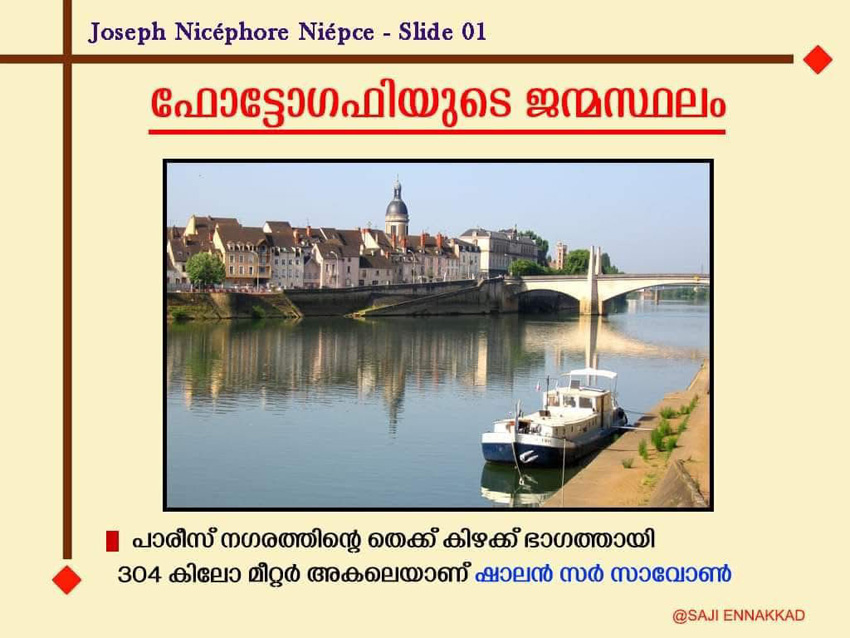
He was born on March 7, 1765, in the small village of Chalon-sur-Saône on the banks of the Saône River in France.
This village lies about 304 kilometers southeast of Paris.
Niépce’s father was a royal adviser and also an official responsible for collecting taxes and deposits from the residents of Chalon. He came from a well-to-do family with one sister and two brothers. From a very young age, he showed a deep curiosity toward scientific subjects.
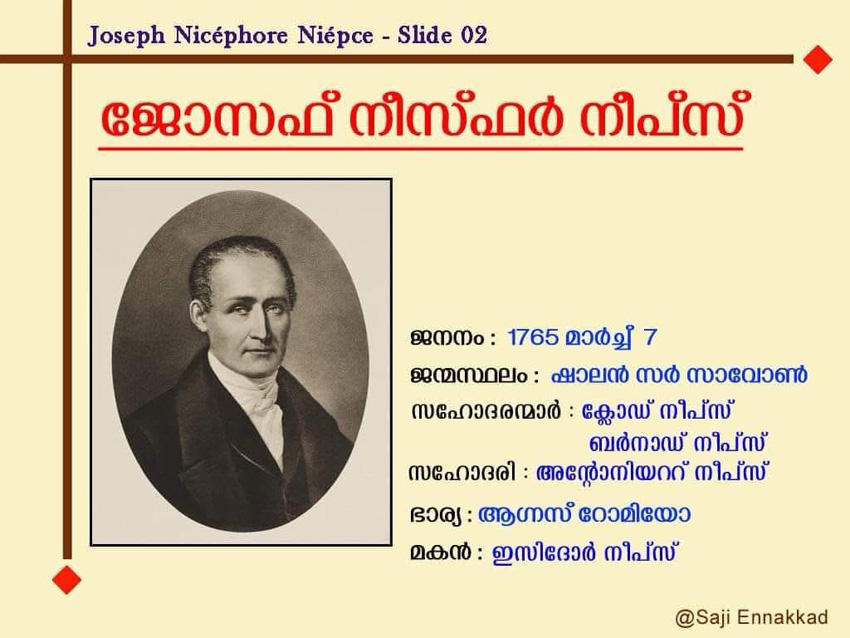
Joseph Nicéphore Niépce had two brothers, Claude Niépce and Joseph Bernard Niépce, and a sister named Antoinette Niépce.
Deeply interested in science, Joseph Niépce studied physics and chemistry in 1786 at the Oratorian Brothers institution in Angers. Soon afterward, he left the Oratorians and in 1788 joined the National Guard at Chalon-sur-Saône. It was there that he adopted the name “Nicéphore.”
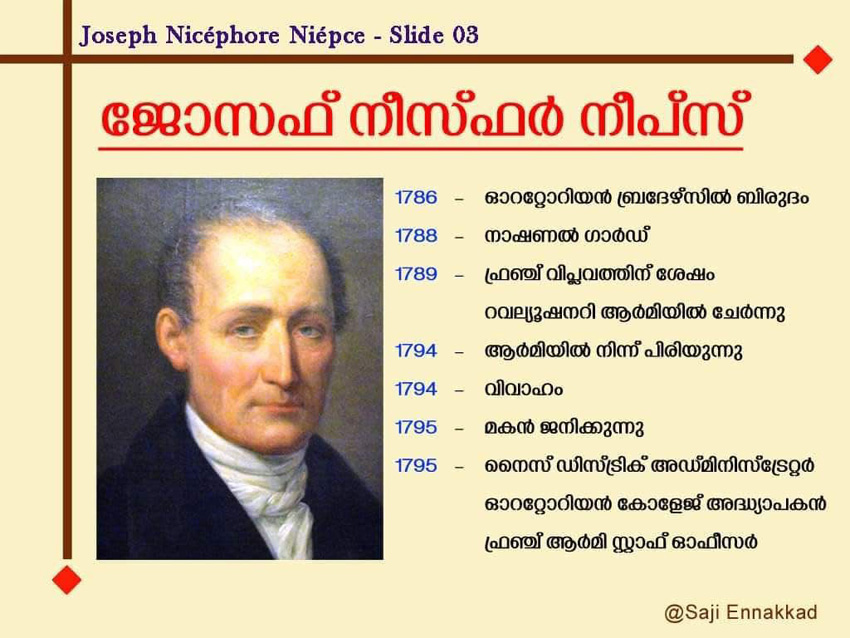
After the French Revolution in 1789, Joseph Nicéphore Niépce joined the Revolutionary Army of the Sardinian Company in southern France. However, due to health issues, he had to leave military service in 1794.
On August 4, 1794, he married a young woman named Agnès Romero and settled in the Nice district. Around this time, his elder brother Claude Niépce also left the army and joined the family.
In 1795, Joseph Nicéphore Niépce’s son, Isidore Niépce, was born. In the same year, Niépce became the Administrator of the Nice district. Alongside this role, he also worked as a teacher with the Oratorian Brothers.
Later, he served as a staff officer in the French Army.
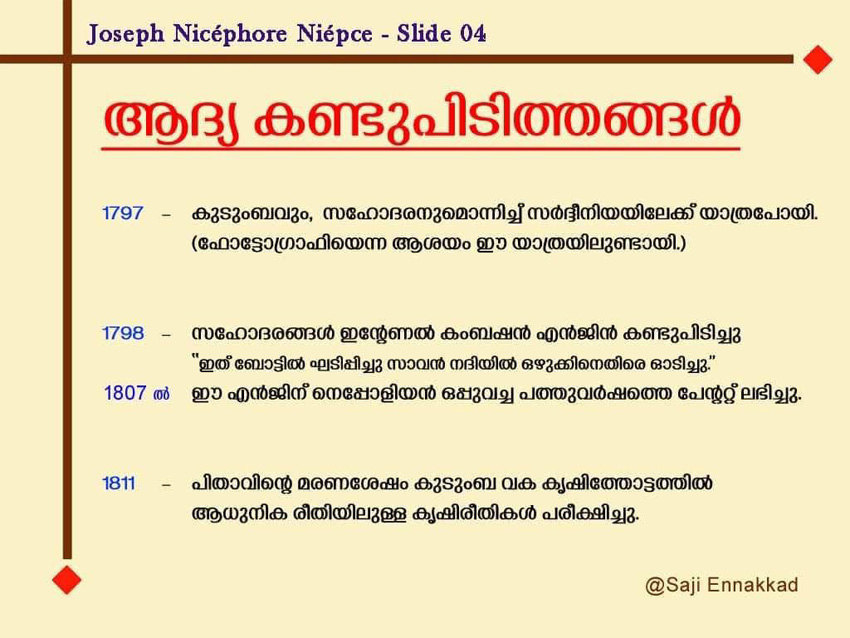
A turning point came in Joseph Nicéphore Niépce’s life in 1797.
He, along with his family and his elder brother Claude Niépce, travelled to Sardinia. It is widely believed that during this journey, the first thoughts and ideas about photography began to take shape in his mind.

In 1798, Joseph Nicéphore Niépce, together with his elder brother Claude Niépce, designed and built an internal combustion engine that operated through controlled explosions related to air expansion. They successfully installed this engine in a boat and ran it upstream on the Saône River.
This invention, achieved even before the discovery of photography, was considered a remarkable scientific accomplishment.

The world’s first internal combustion engine was invented by the Niépce brothers.
On July 20, 1807, they received a patent for this invention from Napoléon Bonaparte. The engine, known as the Pyreolophore, marked a groundbreaking achievement in the early development of mechanical power.
In 1785, Joseph’s father passed away. Until then, his mother had been managing the family estate and residence.
In 1811, Joseph Nicéphore Niépce moved back to the family estate at Saint-Loup-de-Varennes. There, he devoted himself to agriculture, conducting various innovative experiments aimed at improving farming methods.
This period of experimentation and scientific curiosity laid the foundation for his later revolutionary work in photography.
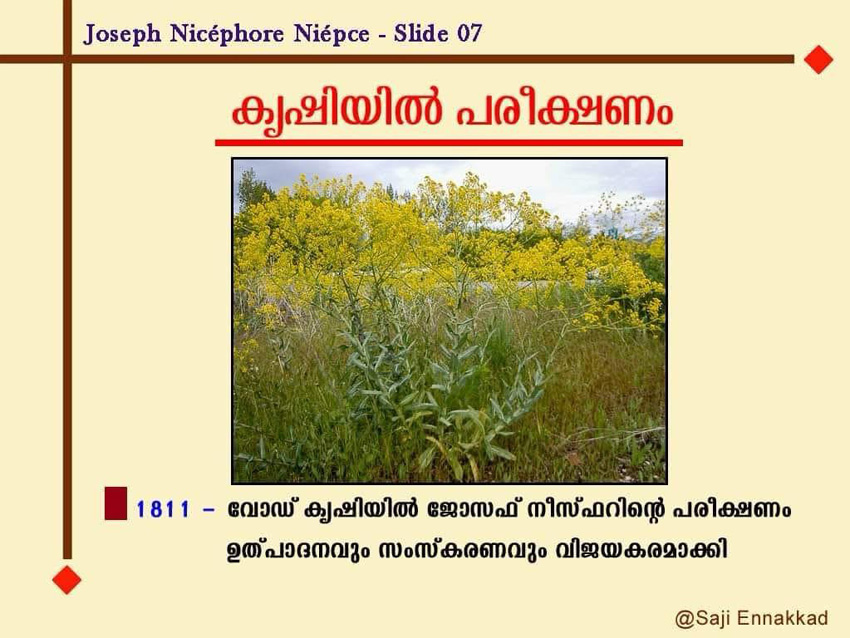
On October 21, 1806, Napoleon Bonaparte issued a decree prohibiting the import of indigo blue dye from England, due to the hostility between Britain and France.
As a substitute for English indigo, the government encouraged the production of blue dye from woad plants. In 1811, a national appeal was made to cultivate woad extensively, and a competition was announced to promote its production.
In response, Joseph Nicéphore Niépce and his brother began cultivating woad on their estate. By applying scientific methods to the production and processing of the plant, they carried out several successful experiments and received commendation from the Ministry for their efforts.
Fifty-six years later, in 1867, a historian who visited Niépce’s estate recorded that woad plants were still growing along the main road and in various parts of the property.
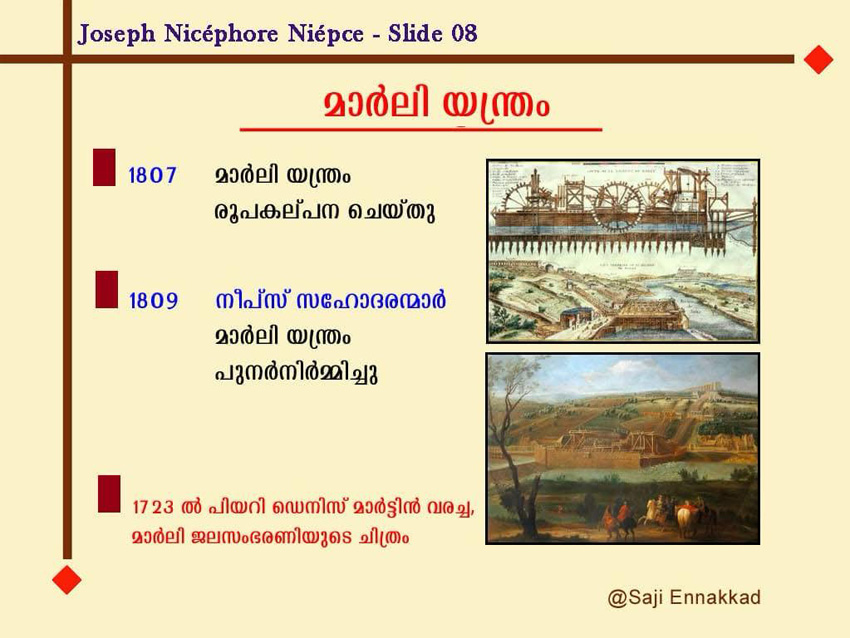
An extraordinary engineering marvel stood at the foot of the hill of Louveciennes, about 12 kilometers from Paris on the banks of the River Seine — the Machine de Marly.
It was built by King Louis XIV to pump water from the Seine River to the Palace of Versailles and to Marly. Construction lasted seven years, and it was inaugurated in June 1684 in the presence of the King. At that time, it was considered one of the wonders of the world.
In 1807, the King decided to hold a competition to redesign and modernize the hydraulic machine. Joseph Nicéphore Niépce and his elder brother Claude Niépce participated in this competition.
In the same year, they submitted a new design for the Marly machine. Their proposal was simpler and more efficient, using fewer wheels and levers. The design was accepted by royal officials and engineers.
On December 8, 1809, Joseph Niépce, his brother, and other engineers worked together to reconstruct the machine.
The Marly project stands as strong evidence of Joseph Nicéphore Niépce’s remarkable engineering skill — long before he became known as the inventor of photography.
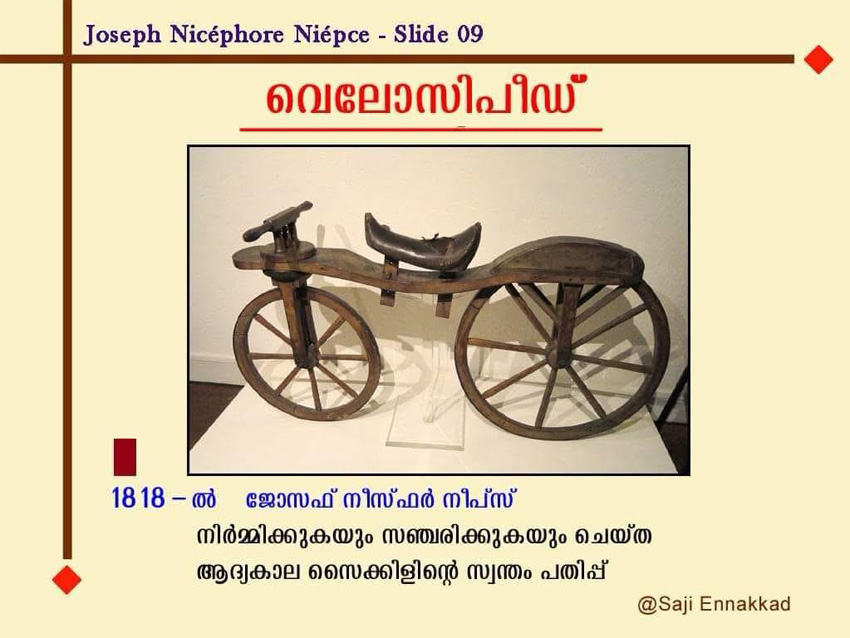
In 1818, Joseph Nicéphore Niépce built a velocipede, which created great curiosity at the time.
This early form of the bicycle was often referred to as the “cousin of the dandy horse” — a pedal-less and transmission-less two-wheeled vehicle. Niépce improved the velocipede and rode it along the village roads of his hometown.
In a letter to his elder brother Claude Niépce, he even wrote about the idea of attaching an engine to the velocipede — an early imagination that hinted at the future concept of the moped.
The velocipede built by Joseph Nicéphore Niépce is still preserved today at the Musée Nicéphore Niépce in France, bearing his name.

In the early 1800s, lithography was a popular medium among artists in France.
The word lithography comes from the ancient Greek words “lithos” meaning stone, and “graphein” meaning to draw.
In 1798, German writer and actor Alois Senefelder invented this technique as an inexpensive method to publish his theatrical works.
Lithography is a printing process in which an image drawn with oil, grease, or wax is applied onto the smooth surface of a lithographic stone (a type of limestone).
From 1813 onward, Joseph Nicéphore Niépce adopted lithography as a creative and experimental medium — a step that would eventually guide him toward his groundbreaking discoveries in photography.

During the early 1800s, lithography became a widespread trend across Europe.
In 1813, Joseph Nicéphore Niépce began experimenting with lithography. Since he was not highly skilled in drawing, the images required for lithographic printing were prepared by his son, Isidore Niépce.
Instead of directly engraving or drawing images onto the lithographic stones, Joseph Niépce developed a different approach. He experimented with using sunlight to transfer and fix images onto the stone surfaces.
This method was innovative and unusual for its time — and it marked an important step toward his later breakthroughs in photography.

On Sunday, June 18, 1815, the Battle of Waterloo took place in France between the French army led by Napoleon Bonaparte and the allied European forces led by Britain.
It is remembered as the final battle of Napoleon Bonaparte — soldier, leader, and Emperor of France.
The Battle of Waterloo became a turning point in the life of Joseph Nicéphore Niépce as well.
For his lithographic experiments, the drawings had been prepared by his son, Isidore Niépce. However, Isidore was forcibly recruited into Napoleon’s army to participate in the war. As a result, Joseph Niépce no longer had someone to create drawings for his lithography work.
In search of a solution, Niépce began using the camera obscura to capture images for lithography. He started experimenting with light-sensitive chemical substances, thinking about how images could be fixed onto lithographic stones.
Using the camera obscura and chemically coated stones, he succeeded in transferring images by himself.
These experiments eventually paved the way for the invention of photography.
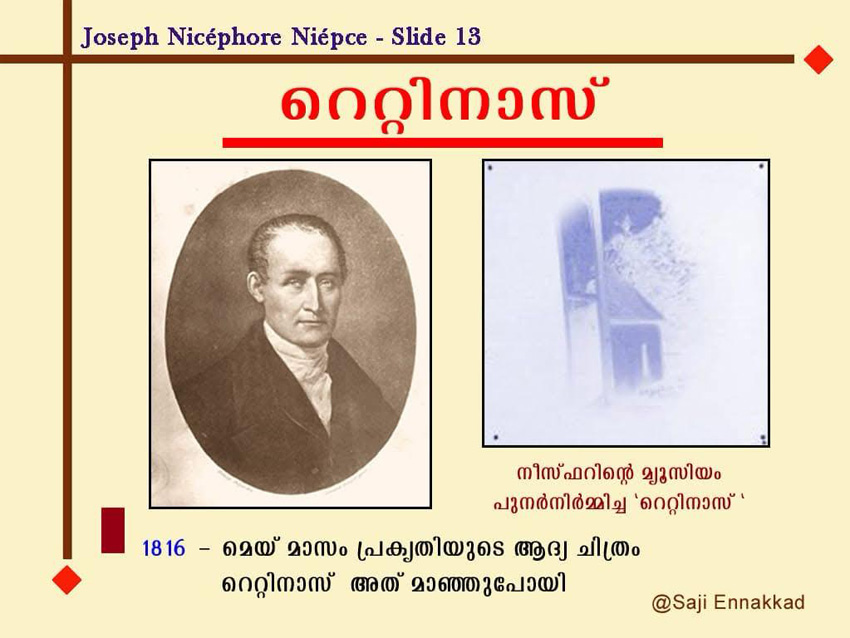
Joseph Nicéphore Niépce continued his experiments with chemical substances. As part of this research, in May 1816, he developed a new process which he called “Retinas.”
Using paper coated with silver salts placed inside a camera obscura, he captured an image of the view from his window.
Although he expected to obtain a positive image, what he received was an inverted negative image of the scene. After a short time, the image darkened when exposed to daylight.
Niépce named this early photographic process “Retinas.” It marked one of the first successful attempts to capture an image of nature through chemical means.
He continued his efforts to obtain a permanent positive image. He experimented with light-bleaching techniques and tested substances such as iron oxide and manganese black oxide. However, these experiments did not produce the desired results.
The “Retinas” shown in the slide is a later reconstruction created by scientists at the Musée Nicéphore Niépce, established in his memory.

In July 1816, the Société d’Encouragement pour l’Industrie Nationale (Society for the Encouragement of National Industry) announced a competition with a prize of 600 francs for the discovery of suitable calcareous stones (a type of limestone) for lithography.
Upon learning about this, Joseph Nicéphore Niépce’s elder brother, Claude Niépce, informed him and even sent a sample of the calcareous stone.
Niépce contacted the organizers of the competition and carefully studied the material. On July 8, 1816, he wrote to his brother Claude, explaining that these stones were highly suitable for lithographic work.
Afterward, in search of proper calcareous stones for lithography, Joseph Nicéphore Niépce traveled through quarries in and around Chalon-sur-Saône, exploring the region extensively.

After discovering suitable calcareous stones for lithography, Joseph Nicéphore Niépce continued his experiments at his estate using the camera obscura.
In 1818, he succeeded in fixing the image of a horse, but the image survived for only about three months.
By 1820, he discovered that a chemical substance extracted from certain materials — Bitumen of Judea — could be coated onto glass or stone surfaces. With the action of light, images could be fixed onto these prepared surfaces.
In July 1822, he achieved a significant milestone. He produced a negative image on a glass surface coated with Bitumen of Judea and created an etched image of Pope Pius VII. However, during his attempt to produce a positive image, the glass negative was accidentally lost.
By 1824, many of his experiments were yielding successful results. He created etched images on various surfaces, including lead-coated copper plates, glass, and stone slabs. Using these negatives, he produced contact prints. One notable etched image from this period was that of Cardinal d’Amboise.

Joseph Nicéphore Niépce considered it a significant achievement that he was able to transfer a scene seen through the camera onto lithographic stone within five days.
The scene he captured was the natural view from the upper-floor window of his estate at Saint-Loup-de-Varennes. However, the image faded away after a short period of time.
In a letter dated September 4, 1824, written to his elder brother Claude Niépce, he described the image as a “marvel without life.”
These persistent efforts brought him ever closer to creating a permanent photograph.

In 1824, Joseph Nicéphore Niépce continued his experiments using Bitumen of Judea.
Through a new experimental method known as aquafortis (acid etching), he transferred images onto copper or brass plates and etched the images onto the metal surfaces.
To better understand how to take prints on paper from these etched copper plates, Niépce sought further guidance from the Parisian painter and engraver Auguste Lemaitre.
These technical explorations in metal etching brought Niépce even closer to refining the permanent photographic process.

In 1825, Joseph Nicéphore Niépce continued his experiments in the lithographic process. This time, he used a mixture of Bitumen of Judea and lavender oil (asphalt) for his work.
Using the lithographic technique, he produced a paper print of an image depicting a 17th-century Flemish subject — a man leading a horse.
This print is considered one of the very few surviving artistic works of Joseph Nicéphore Niépce. The Bibliothèque nationale de France later acquired this historic piece for more than 400,000 francs and has preserved it as part of the nation’s cultural heritage.

Parisian opticians played a crucial role in influencing the invention of photography.
Charles Louis Chevalier (1804–1859), along with his father Vincent Jacques Louis Chevalier, was associated with a well-known optical company in Paris. The family business, established in 1765 under the name Vincent and Charles, gained great recognition in the city.
They were experts in optics and also manufacturers of scientific and musical instruments. The company became widely respected for its precision instruments.
Vincent Chevalier developed achromatic lenses, which were especially suitable for use in the camera obscura.
Joseph Nicéphore Niépce purchased lenses from their company and maintained a close professional relationship with them. Their optical advancements greatly supported his photographic experiments.

Joseph Nicéphore Niépce purchased lenses from the Parisian optical firm Vincent and Charles, operated by Vincent Chevalier and Charles Chevalier.
As a frequent visitor to their workshop, Niépce requested in 1825 that they refine his camera and fit it with suitable, high-quality lenses.
During this period, he was deeply engaged in experiments to produce positive images on tin plates made from zinc and copper.
In 1826, he acquired a new large camera, improved lenses, and pewter plates necessary for image fixing from the Parisian opticians. He then began his attempt to capture the natural view from the upper-floor window of his estate.
The upper floor of his estate had effectively become a large experimental laboratory — the birthplace of one of history’s greatest inventions.

About 7.5 kilometers from Niépce’s birthplace, Chalon-sur-Saône, lies Saint-Loup-de-Varennes. It was in the summer residence on this estate that Joseph Nicéphore Niépce lived with his family. The upper floor of this house functioned as his experimental laboratory.
In 1826, Niépce purchased a new large camera and several pewter plates (an alloy sheet made primarily of tin with lead and copper) from Parisian opticians. Using these, he continued his experiments to produce a permanent positive image.
From the laboratory window on the upper floor of his estate, he attempted to focus the courtyard, buildings, and trees onto a prepared pewter plate.
Around June or July 1827, he successfully fixed the positive image.
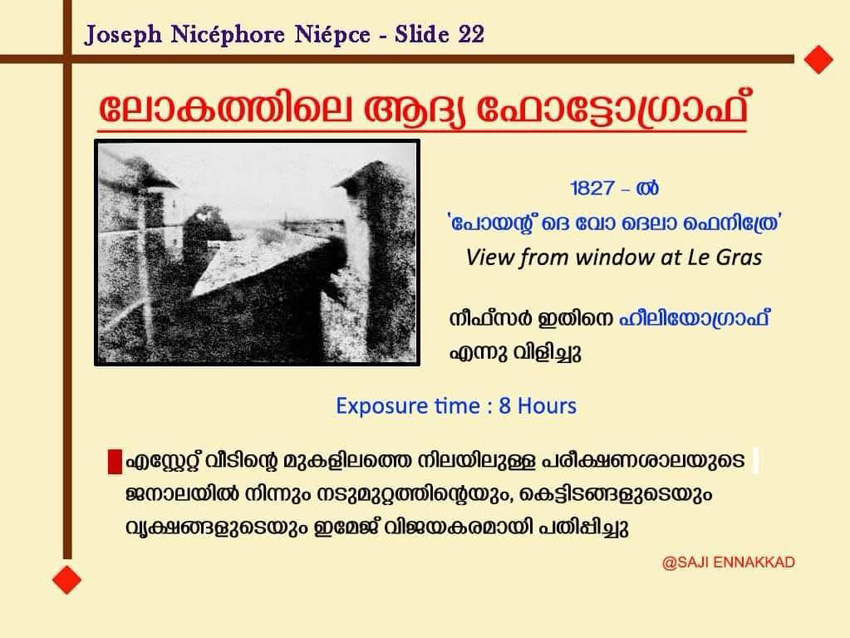
The result was “Point de Vue de la Fenêtre” (View from the Window at Le Gras) — the world’s first successful photograph.
Niépce called this process “Heliography.”
“Helio” means sun, and “graphy” means drawing — literally, drawing with sunlight.
The first photograph required approximately eight hours of exposure. As the sun moved from east to west, light illuminated different parts of the scene, resulting in the unique lighting visible across the image.
Thus, the world’s first successful photograph was born through the hands of the French scientist Joseph Nicéphore Niépce.
In the image frame, one can observe the sloping roof of a barn, the sky visible above the treetops, the tall chimney of the bakehouse on the left, and the roof of another building on the right.
Until 1898, the photograph was exhibited at various locations in London. After being displayed at the famous Crystal Palace, its whereabouts remained unknown for nearly half a century. (The story of its rediscovery comes later.)
On March 20 and 21, 1952, a copy of the first photograph was made at the research laboratory of the Eastman Kodak Company in London.
In 2002, the J. Paul Getty Museum in Los Angeles scientifically examined and confirmed the authenticity of the photograph.
Since 2003, the original photograph has been preserved and displayed for the public at the Harry Ransom Center at the University of Texas, USA.

Joseph Nicéphore Niépce’s elder brother, Claude Niépce, traveled to Paris in 1816 and then to London the following year. The purpose of the journey was to explore the commercial potential of the internal combustion engine invented by the Niépce brothers.
While in London, Claude Niépce fell seriously ill. In September 1827, Joseph Nicéphore Niépce, accompanied by his wife Agnès Romero, traveled to London to visit his ailing brother.
He carried with him several heliographic prints — including the first photograph — five prints in total, intending to show them to his brother.
In London, Claude introduced Joseph to his friend Francis Bauer, a Fellow of the Royal Society and a distinguished botanist.
Niépce presented the heliographic prints he had brought from Paris to Francis Bauer and explained his experiments in detail.
Recognizing the novelty and importance of heliography (photography), Bauer encouraged Niépce to prepare a research paper so that the invention could be presented to the Royal Society in London for official recognition.

Louis Jacques Mandé Daguerre — commonly known as Louis Daguerre — was the inventor of the Diorama.
A diorama was a theatrical show that used dramatic lighting effects to create moving and changing visual scenes. Paris was the center of his activities.
In 1826, after learning about Joseph Nicéphore Niépce from the Parisian opticians Vincent and Charles Chevalier, Daguerre obtained Niépce’s address from them.
In September 1827, while traveling to London with his wife Agnès Romero, Joseph Nicéphore Niépce met Louis Daguerre for the first time in Paris and visited his Diorama. During this meeting, Niépce explained in detail his heliographic experiments — including the first photograph.
They met again during Niépce’s return journey from London.
On February 3, 1828, Louis Daguerre wrote his first letter to Joseph Nicéphore Niépce, expressing his strong interest in Niépce’s discoveries.

The image shown here is the original pewter plate of the world’s first successful photograph — View from the Window at Le Gras.
This historic plate, created by Joseph Nicéphore Niépce, marks the birth of photography.
At the suggestion of Royal Society Fellow Francis Bauer, Joseph Nicéphore Niépce prepared a handwritten manuscript explaining the heliographic process.
On December 8, 1827, it was presented to the Royal Society of Great Britain. However, Niépce did not reveal the secret formula of the heliographic process. As a result, the panel of scientists declined to grant official recognition to heliography.
The Royal Society neither acknowledged heliography (photography) as a new invention nor awarded any scholarship or support. Thus, the world’s first successful photograph did not receive official recognition in 1827.
In January 1828, after bidding farewell to his ailing brother Claude Niépce, Joseph Nicéphore Niépce returned to Paris with his wife Agnès Romero. Before leaving London, he entrusted five heliographic prints and his handwritten manuscript to Francis Bauer.
In February 1828, Claude Niépce passed away in London. By then, Joseph Nicéphore Niépce and his wife had already returned to their home at Le Gras in France.

Joseph Nicéphore Niépce succeeded in extracting a photosensitive vapor from lavender oil.
In June 1830, Niépce and Louis Daguerre conducted experiments together for two weeks at the estate in Saint-Loup-de-Varennes.
By 1832, the vapor extracted from lavender oil was used as a photographic agent. It was coated onto glass or metal surfaces and allowed to dry. Once dried, the surface appeared as though covered with a fine powder.
These prepared glass or metal plates were then exposed inside a camera obscura. A positive image was obtained, and through additional chemical processes, the image was fixed permanently.
Joseph Nicéphore Niépce named this process “Physautotype.”
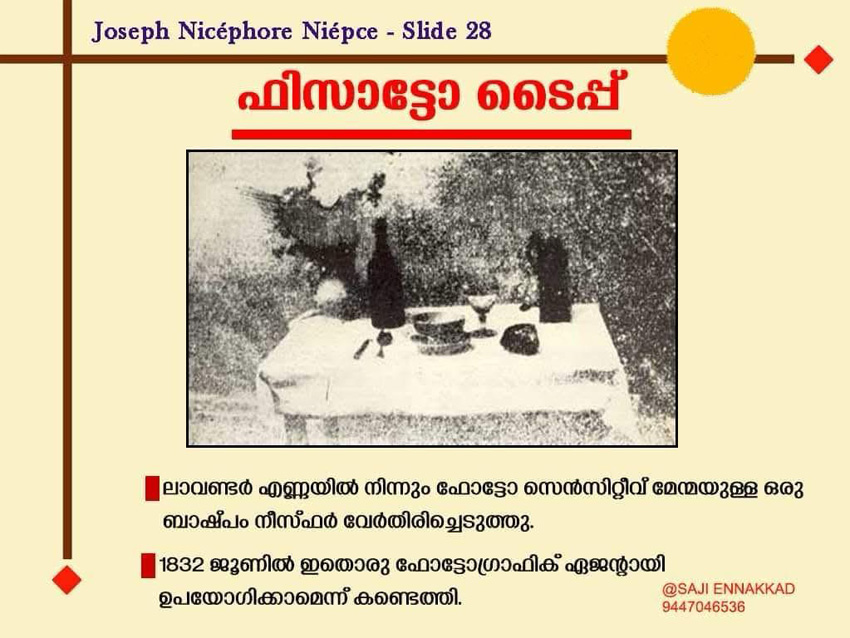
Joseph Nicéphore Niépce extracted a photosensitive vapor from lavender oil.
In June 1830, Niépce and Louis Daguerre carried out experiments together for two weeks at the estate in Saint-Loup-de-Varennes.
By 1832, the vapor derived from lavender oil was used as a photographic agent. It was coated onto glass or metal surfaces and allowed to dry. Once dried, the surface appeared as if covered with a fine powder.
These prepared glass or metal plates were then exposed inside a camera obscura. A positive image was obtained, and through additional chemical processes, the image was fixed.
Joseph Nicéphore Niépce named this process “Physautotype.”

In November 1832, Louis Daguerre traveled from Paris to Saint-Loup-de-Varennes to continue work on their new photographic project. He stayed at Joseph Nicéphore Niépce’s estate and collaborated with him in further experiments.
Afterward, Niépce continued the experiments largely at his own expense. Ignoring his health, he worked daily with chemical substances and carried out intense and demanding experiments. As a result, he developed serious health problems.
Without waiting to see the official public recognition of his invention, Joseph Nicéphore Niépce passed away on July 5, 1833, after suffering a sudden stroke.
He left this world before witnessing the full acknowledgment of the discovery that would change history forever.
After the sudden death of Joseph Nicéphore Niépce, his son and heir, Isidore Niépce, continued the partnership agreement with Louis Daguerre. However, Isidore was unable to advance his father’s original inventions independently. He nevertheless continued collaborating with Daguerre.
The Physautotype process was still being pursued in 1835, with the main objective of reducing the exposure time required to take a photograph.
Since Daguerre did not possess deep expertise in chemistry, the experimental work was entrusted to the laboratory of Jean-Baptiste Dumas, President of the Society for the Encouragement of Science. Dumas recommended the use of sodium hyposulfite (hypo), a fixing agent previously experimented with in 1819 by John Herschel.
By 1837, Daguerre succeeded in exposing images on silver-plated copper sheets treated with iodine in a camera. The exposed image was then developed using mercury vapor.
Daguerre claimed this invention under his own name and called it the “Daguerreotype.”

In 1837, Louis Daguerre advertised for sponsorship to continue developing his process. Only a few showed interest. Among them was François Arago, Director of the Paris Observatory and Secretary of the French Academy of Sciences. Arago was not only a respected scientist but also an influential political figure in the French Parliament.
Taking the initiative, Arago announced the Daguerreotype process in the Literary Gazette of the French Academy of Sciences on January 7, 1839. Until the official declaration by the Academy, Daguerre did not reveal the secret details of the process.
There were prolonged negotiations between Daguerre and the French government regarding financial compensation. Eventually, both Louis Daguerre and Isidore Niépce were granted annual pensions of 4,000 francs each. Additionally, Daguerre received 2,000 francs for the renovation of his Diorama.
On August 19, 1839, under the leadership of the Academy of Sciences, Daguerre formally announced the Daguerreotype process. Although Daguerre had originally partnered with Joseph Nicéphore Niépce in their photographic experiments, after Niépce’s death he presented the results largely under his own name.
Lady Elizabeth Eastlake, one of the earliest historians of photography, later described that day in her book Photography as “a day of cruel injustice” in the history of photography.
In 1837, Louis Daguerre placed an advertisement seeking sponsorship to continue developing his photographic process. Only a few individuals showed interest. Among them was François Arago, Director of the Paris Observatory and Secretary of the French Academy of Sciences. A skilled politician with strong influence in the French Parliament, Arago played a decisive role in promoting Daguerre’s invention.
On January 7, 1839, Arago announced the Daguerreotype process in the Literary Gazette of the French Academy of Sciences. Until the Academy made its official declaration, Daguerre kept the technical details of the process secret.
Negotiations between Daguerre and the French government regarding financial compensation continued for some time. Eventually, annual pensions of 4,000 francs each were granted to Daguerre and Isidore Niépce. In addition, Daguerre received 2,000 francs for improvements to his Diorama.
On August 19, 1839, under the leadership of the Academy of Sciences, Daguerre formally announced the Daguerreotype process. Although he had originally collaborated with Joseph Nicéphore Niépce under a partnership agreement, after Niépce’s death Daguerre presented the results largely under his own name.
Lady Elizabeth Eastlake, one of the earliest historians of photography, later described this day in her book Photography as “a day of cruel injustice” in the history of photography.
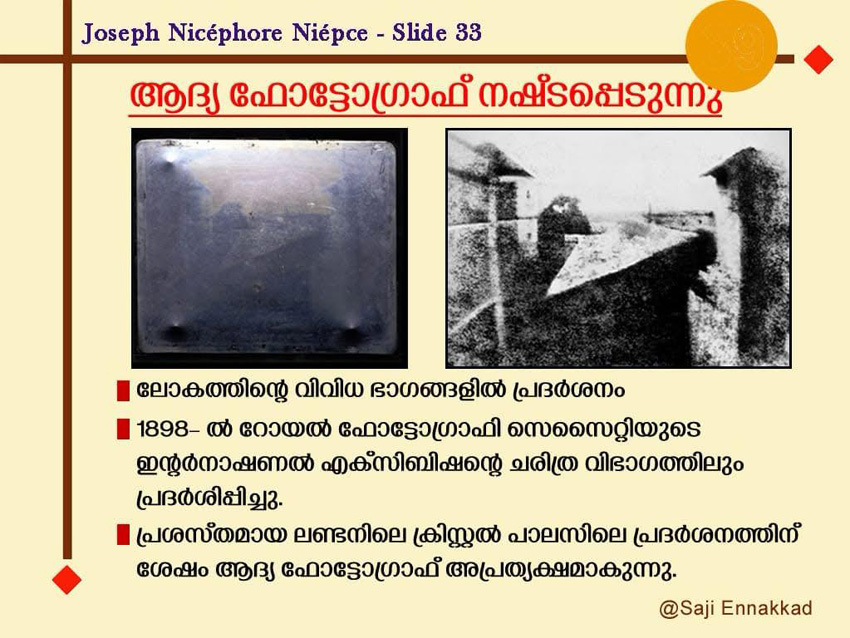
As mentioned earlier, Joseph Nicéphore Niépce entrusted the first photograph (heliograph), its handwritten manuscript, and four additional heliographic prints to Francis Bauer before returning from London.
The first public exhibition of the original photograph took place at the Royal Society in London in 1827. It was later exhibited six times at different locations. The final exhibition was held in 1898 at the famous Crystal Palace in London under the leadership of the Royal Society.
After that, the whereabouts of the photograph became unknown.
In 1947, modern photography historian Helmut Gernsheim began researching in order to locate the world’s first photograph. In 1950, he published an appeal in The Observer newspaper in London, seeking information about its location.
His investigation began by tracing the connection back to the botanist Francis Bauer.

After 1898, no one knew the whereabouts of the world’s first successful photograph.
From 1947 onward, Helmut Gernsheim began a determined search to rediscover it. In 1950, he placed a public appeal in The Observer newspaper in London. His wife, Alison Gernsheim, strongly supported him in this investigation.
After being missing for 54 years, the first successful photograph — “Point de Vue de la Fenêtre” (View from the Window at Le Gras) — was finally rediscovered and reintroduced to the world, thanks to Helmut Gernsheim’s efforts.
Gernsheim’s passion for photography was extraordinary. He collected more than 33,000 photographs, over 4,000 books on photography, and numerous related documents.
Among his greatest contributions is his monumental work on modern photographic history:
The History of Photography: from the Camera Obscura to the Beginning of the Modern Era.
This book remains one of the most important and comprehensive studies in the history of photography.
The search for the missing first photograph continued.
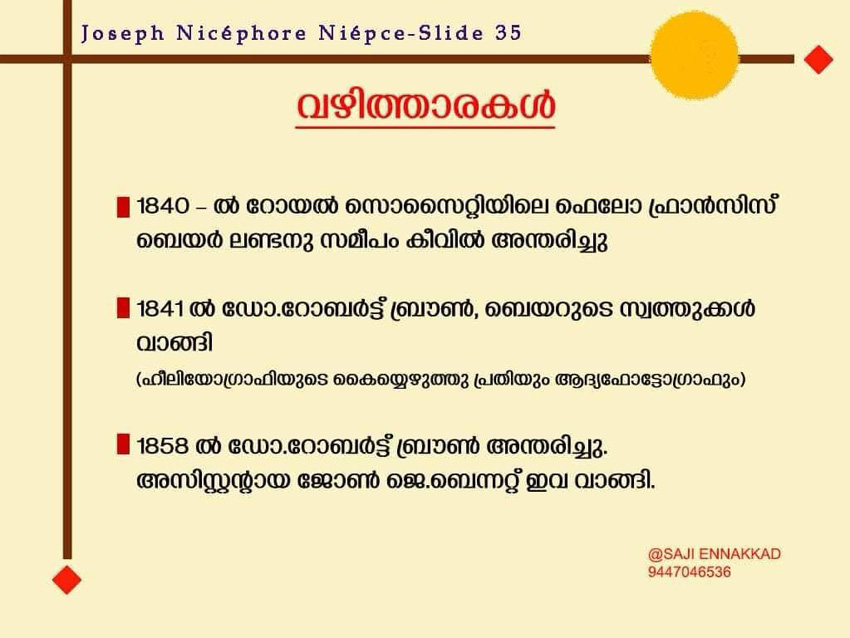
Modern photography historian Helmut Gernsheim began his investigation by tracing the connection to Francis Bauer, the Royal Society Fellow and botanist to whom Niépce had entrusted the heliograph and related materials. Francis Bauer passed away in 1840 at Kew, near London.
On November 24, 1841, Robert Brown, also a Fellow of the Royal Society, acquired Bauer’s estate and belongings. Among these items were Joseph Nicéphore Niépce’s first photograph, the handwritten manuscript on heliography, and four additional works.
After Robert Brown’s death in 1858, his assistant John Joseph Bennett purchased these possessions.
Following Bennett’s death in April 1884, his estate was auctioned — setting the stage for the next chapter in the remarkable journey of the world’s first photograph.
The history of rediscovering the first photograph continues.
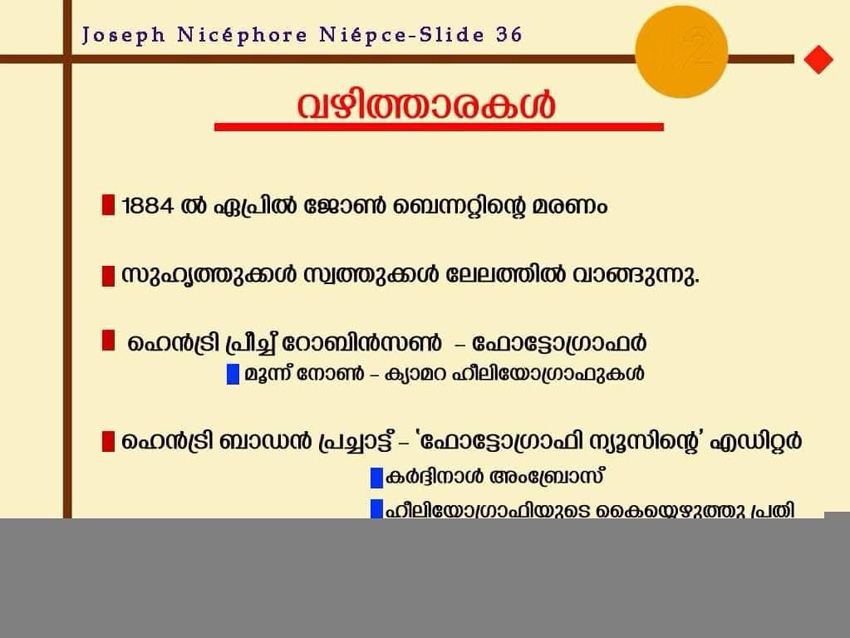
In 1884, John Joseph Bennett passed away. After his death, his belongings were auctioned. His friends and assistants — Henry Baden Pritchard, editor of Photography News, and the photographer Henry Peach Robinson — jointly purchased the materials at the auction.
Among the items were the artistic works of Joseph Nicéphore Niépce. The two men divided the collection equally between them.
Henry Baden Pritchard received the first photograph, the handwritten manuscript on heliography, and the non-heliographic print of Cardinal d’Amboise. Henry Peach Robinson received the remaining three non-heliographic prints.
Thus, Niépce’s creations were divided into two hands.
Later, the Royal Society acquired the first photograph from Henry Baden Pritchard for exhibition purposes.

The difficult search for the world’s first successful photograph continued.
On May 11, 1884, Henry Baden Pritchard died of pneumonia. The first photograph then came into the possession of his wife, Mary Pritchard.
In 1917, Mary Pritchard also passed away. Her relatives placed the first photograph, the handwritten manuscript on heliography, and the non-heliographic print into an iron trunk along with old clothes and household belongings. These items were stored in a warehouse (godown) in London.
Over time, the family forgot about the trunk — and with it, the priceless first photograph remained hidden and unknown.

In July 1950, Helmut Gernsheim formally concluded his initial search for the first photograph. In his later investigations, he began referring to it more precisely as a “heliograph” rather than simply the first photograph.
He continued his research by publishing an article in the British Journal of Photography.
After the death of Henry Baden Pritchard’s son in 1952, his widow became the heir to the family possessions. That same year, she read Gernsheim’s article and suddenly remembered the old iron trunk stored in a London warehouse, which contained prints kept among old clothes. She arranged for the trunk to be retrieved from storage.
Inside, along with the old garments, they discovered the long-lost first photograph. She immediately informed Helmut Gernsheim and invited him to come and see Joseph Nicéphore Niépce’s remarkable creation.
On February 14, 1952, Helmut Gernsheim arrived to view the photograph. Holding the priceless treasure in his hands, he was overwhelmed with emotion and, for a few moments, was unable to speak.
It was one of the most unforgettable moments of his life.

February 14, 1952, became one of the most unforgettable days in the life of modern photography historian Helmut Gernsheim.
On the back of the first photograph (heliograph), Francis Bauer, a Fellow of the Royal Society in London, had attached a thick green paper bearing the handwritten note:
“Monsieur Niépce’s First successful experiment of fixing permanently the image from Nature”
It was dated 1827 and signed by Bauer himself.
For Gernsheim, this inscription was sufficient proof of the photograph’s authenticity. Along with the first photograph, two other works by Joseph Nicéphore Niépce were also present.
The daughter-in-law of editor Henry Baden Pritchard generously presented this priceless treasure to Gernsheim.
On April 15, 1952, Helmut Gernsheim officially announced to the world — through The Times newspaper in London — that the world’s first photograph, missing for 54 years, had finally been rediscovered.
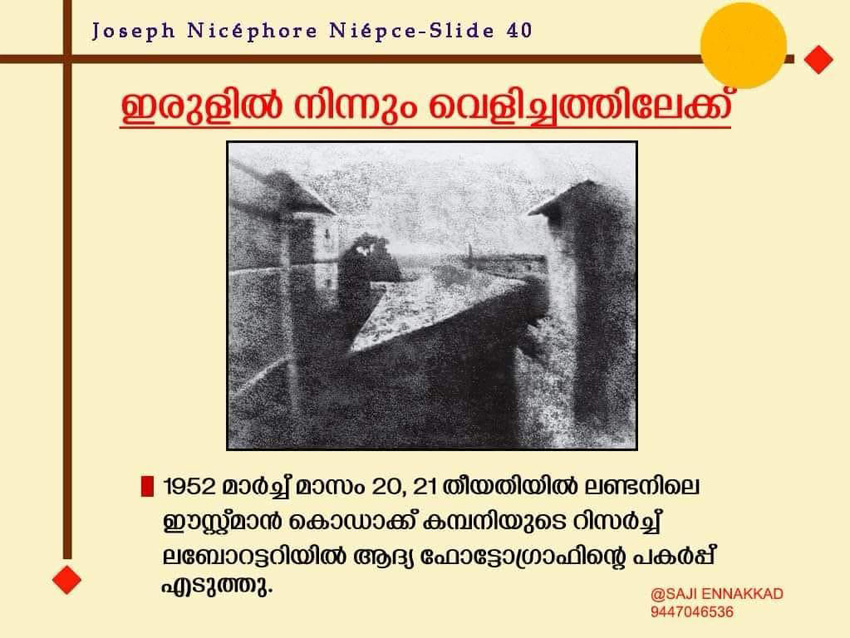
At the request of modern photography historian Helmut Gernsheim, a copy of the first photograph was made at the laboratory of the Eastman Kodak Company in London.
This took place on March 20 and 21, 1952.
A gelatin silver print, enhanced with watercolor, was produced as a reprint of the original photograph. The entire process was carried out in the full presence of Helmut Gernsheim.
The image shown in this slide is the copy produced during that historic reprinting process.
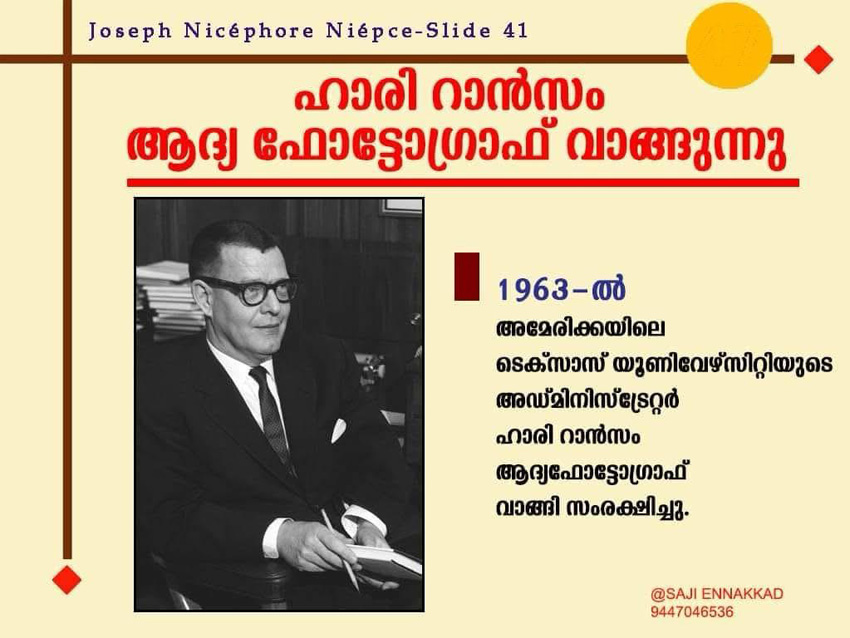
Harry Huntt Ransom, an administrator at the University of Texas, served as President of the University in 1960 and as Chancellor from 1961 to 1971.
Recognizing the rarity and immense value of the heliograph (the first photograph), he expressed his willingness to acquire the photography collection of modern photography historian Helmut Gernsheim on behalf of the University.
Gernsheim gladly sold his collection to the University for a fair compensation. However, the priceless treasure — the first photograph — was donated by him to the University as a gift.
For rediscovering the long-lost first photograph and restoring it to the world, Helmut Gernsheim and his wife, Alison Gernsheim, refused to accept any reward or personal benefit from anyone.

In 1963, the University of Texas at Austin officially received the world’s first photograph from modern photography historian Helmut Gernsheim.
The priceless heliograph — View from the Window at Le Gras — thus found a permanent home in the United States, preserved for future generations as a landmark in the history of photography.

In June 2002, the J. Paul Getty Museum in Los Angeles conducted a scientific examination and analysis of the first photograph at the request of the Harry Ransom Humanities Research Center of the University of Texas.
A team of scientists from the Getty Conservation Institute (GCI) led the investigation. The tests included:
• X-ray Fluorescence (XRF)
• Fourier-Transform Infrared Spectrometry (FTIR)
• Reflection Spectrophotometry
Through XRF analysis, the composition of the pewter plate used to create the first photograph was examined. Further scientific testing confirmed the authenticity of the world’s first photograph.
A video of this scientific verification has been posted — please watch it as well.

A team of scientists from the Getty Conservation Institute (GCI) at the J. Paul Getty Museum in Los Angeles conducting scientific analysis of the first photograph and a non-heliographic print.
Through advanced conservation and analytical techniques, they carefully examined and verified the authenticity and material composition of these historic works.
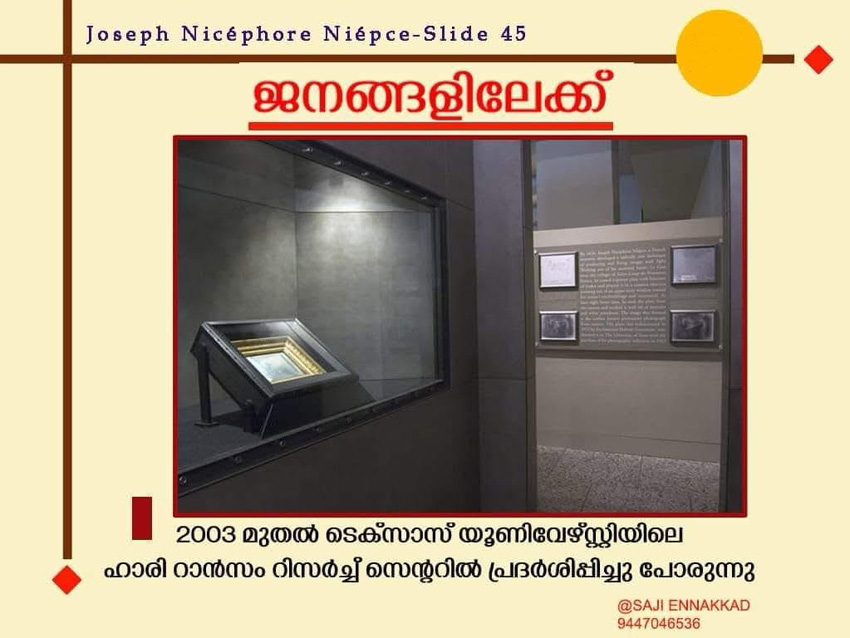
Since 2003, the first photograph has been preserved at the Harry Ransom Center at the University of Texas, USA.
It is housed inside a special conservation chamber filled with inert gas and mounted at an approximate 30-degree viewing angle in an elegant metal frame.
The chamber is carefully illuminated so that visitors can clearly view the image.
The original pewter plate bearing the first photograph is framed using a metal support and protective Plexiglas.
Today, the world’s first successful photograph is safely preserved and made accessible for public viewing.

On the reverse side of the first photograph, a thick green paper had been attached.
On it were written the words:
“1827 Heliography – Joseph Nicéphore Niépce”
and
“Monsieur Niépce’s First successful experiment of fixing permanently the image from Nature.”
This inscription was written and signed by the botanist Francis Bauer.
At the Harry Ransom Center of the University of Texas, this historic handwritten note has been enlarged and displayed prominently for visitors to see.

The first photograph is preserved at the Harry Ransom Research Center at the University of Texas in Austin, USA.
Following the recommendations of the Getty Conservation Institute, it is displayed inside an airtight, oxygen-free chamber.
The display system has been under the supervision of the Getty Conservation Institute since 1989.
Inside the chamber, oxygen levels, air pressure, humidity, and temperature are measured every hour using a central data logger. The collected data is transmitted with precision to the Environmental Studies Laboratory of the Getty Conservation Institute for continuous monitoring.
This level of preservation is comparable to the methods used to protect the Egyptian mummies in the Egyptian Museum in Cairo and the original handwritten Constitution of India in the Parliament Library in New Delhi.
In other words, the world’s first photograph is preserved with the highest degree of scientific care and vigilance.

The estate at Saint-Loup-de-Varennes was the summer residence of Joseph Nicéphore Niépce, the inventor of photography.
It was here that he cultivated woad plants, and this very residence also served as his photography laboratory. The upper floor of the estate functioned as a large experimental workspace.
From the window on that upper floor, he attempted to capture images of nature — an effort that ultimately led to the creation of the world’s first successful photograph.
The French government later declared this estate a National Heritage Monument. Today, the historic building stands as a museum dedicated to the memory and achievements of Joseph Nicéphore Niépce.
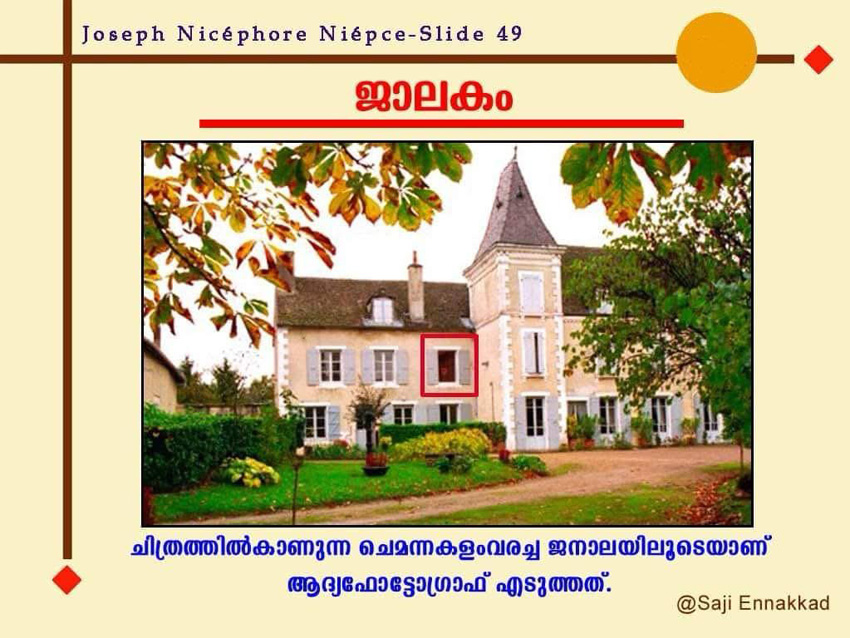
Joseph Nicéphore Niépce captured the world’s first photograph from the upper-floor window of his estate at Saint-Loup-de-Varennes.
The window shown in the image is the very window through which the first photograph was taken — the historic opening that gave birth to photography.
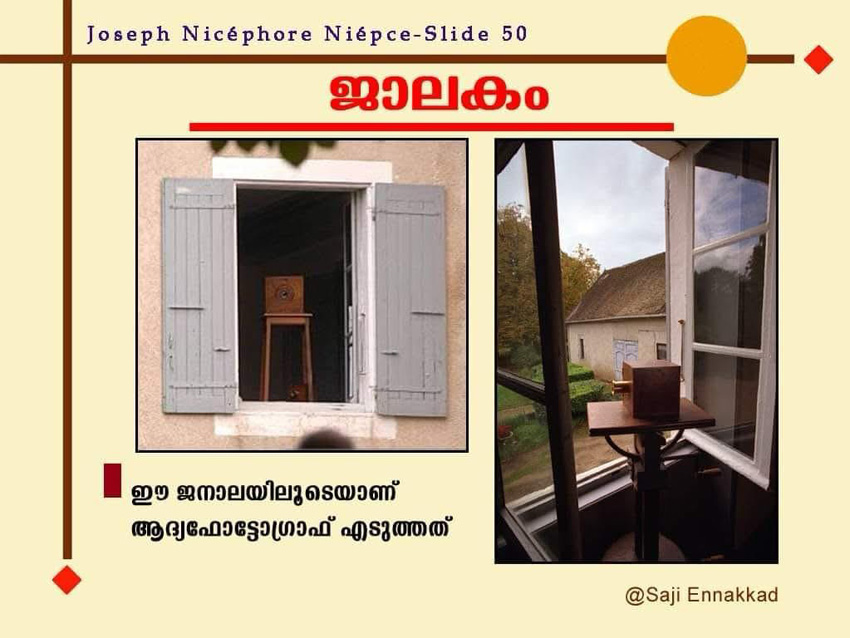
Joseph Nicéphore Niépce captured the world’s first photograph from the upper-floor window of his estate at Saint-Loup-de-Varennes.
The window shown in the image is the very same window through which the first photograph — the birth of photography — was created.
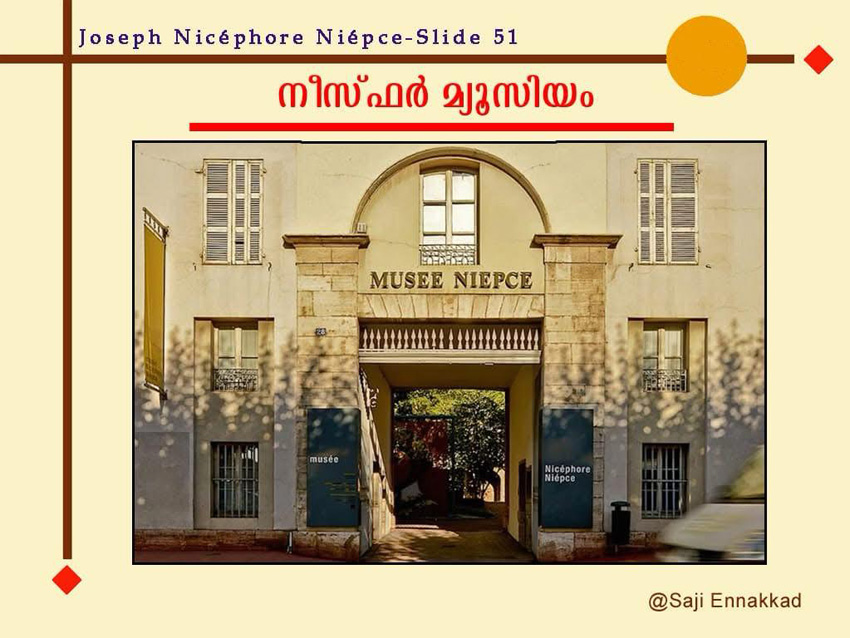
The estate at Saint-Loup-de-Varennes was the summer residence of Joseph Nicéphore Niépce, the inventor of photography.
This very residence also served as his photography laboratory, where he conducted the experiments that led to the birth of photography.
The French government declared Niépce’s estate a National Heritage Monument. Today, the building functions as a museum dedicated to Joseph Nicéphore Niépce.
The image shown in this slide is the entrance to the museum.
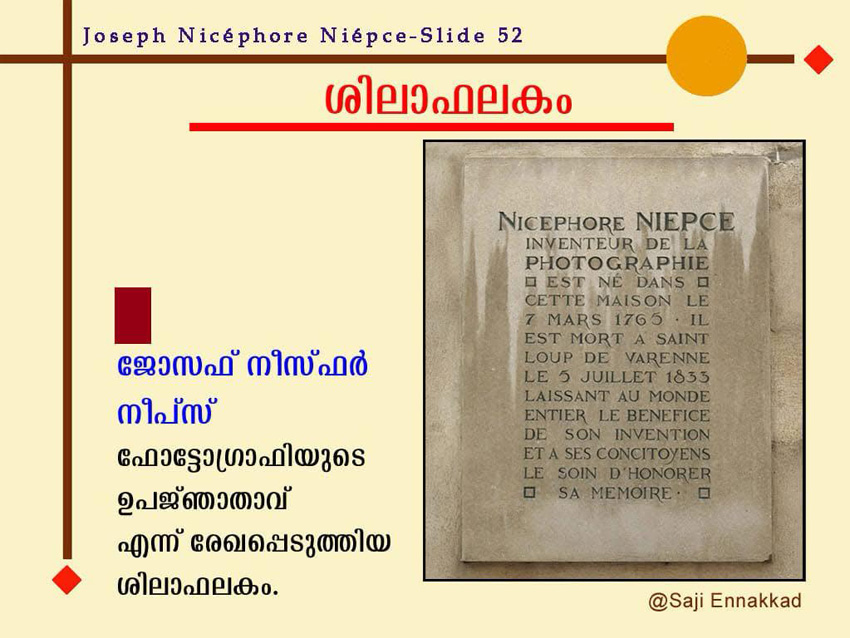
A commemorative plaque identifying Joseph Nicéphore Niépce as the Inventor of Photography.
This plaque is installed on the wall of the Maison Nicéphore Niépce at Saint-Loup-de-Varennes, which has been declared a National Heritage Monument.
It stands as an official recognition of the man whose experiments gave birth to photography.
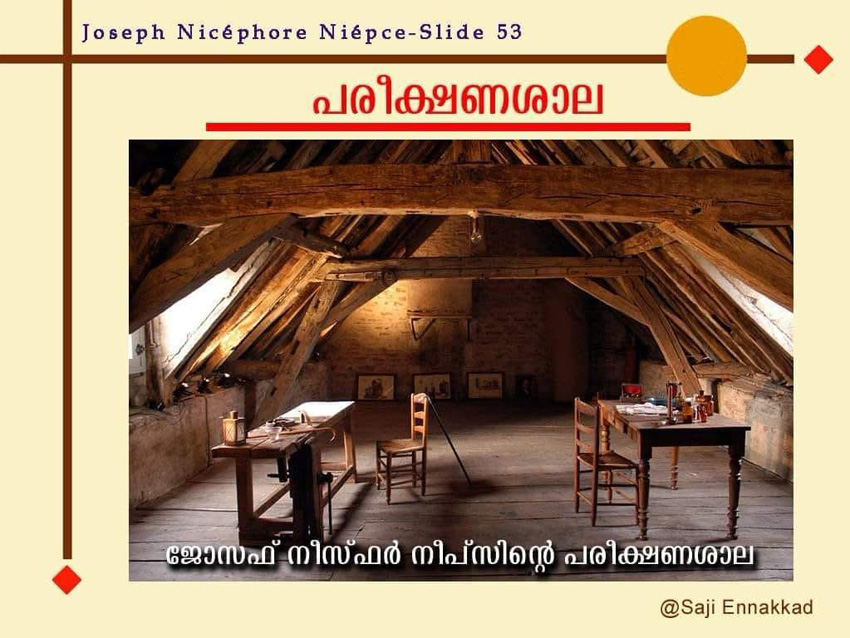
The estate at Saint-Loup-de-Varennes was the summer residence of Joseph Nicéphore Niépce, the inventor of photography.
This very residence also served as his photographic laboratory.
The image shown in this slide is the upper floor of the estate — the space where Niépce conducted the experiments that led to the birth of photography.

For the continuation of this historical journey,
please refer to Slides 40 onwards in the History of Photography series.
From the scientific verification of the first photograph…
to its preservation at the Harry Ransom Center…
and finally to the recognition of Joseph Nicéphore Niépce’s legacy —
the story unfolds as a powerful reminder that history may be delayed,
but truth eventually shines through.

Joseph Nicéphore Niépce, the inventor of photography, carried out his long and tireless photographic experiments at his summer residence in Saint-Loup-de-Varennes.
Working relentlessly without rest, his health gradually declined. Without waiting to see the official recognition of his discoveries, Joseph Nicéphore Niépce suffered a sudden stroke and passed away on July 5, 1833, at the age of 68.
He was laid to rest in the cemetery at Saint-Loup-de-Varennes — the same village where photography was born.

The handwritten signature of Joseph Nicéphore Niépce,
the inventor of photography.
This signature stands as a personal mark of the man whose perseverance and scientific curiosity gave birth to photography — a simple stroke of ink that changed the course of visual history forever.

The world’s first successful photograph was created by the French scientist Joseph Nicéphore Niépce.
To preserve his memory, a full-length statue has been erected in his birthplace, Chalon-sur-Saône, on the banks of the River Saône.
At the base of the statue, it is inscribed:
“Inventor of Photography.”
A lasting tribute to the man who gave the world its first permanent image.

The world-renowned painter, photographer, and sculptor Man Ray, though born in America, became Parisian by artistic destiny. He was one of the leading figures of the Dada movement in modern art.
In July 1921, after settling in Paris — then the center of avant-garde art — Man Ray developed a new printing technique known as the photogram (which he called “Rayographs”). For nearly twenty years in Paris, he remained a distinctive and revolutionary presence in photographic history.
Realizing that Joseph Nicéphore Niépce, the inventor of photography, had been pushed into the background of history, Man Ray took it upon himself to honor Niépce’s extraordinary contributions and to inspire the world to remember him. His ambition was to build a grand memorial for the father of photography.
In 1933, near Niépce’s birthplace by the River Saône, along the main road at Saint-Loup-de-Varennes, Man Ray constructed a massive marble monument approximately 50 feet long and 20 feet high. On it was inscribed in large letters:
“Joseph Nicéphore Niépce – Inventor of Photography”
along with the year 1822.
The year 1822 was significant because it marked Niépce’s early success in fixing an image on a glass plate using Bitumen of Judea — an early form of heliography.
The monument was built with financial contributions from local residents.
However, Man Ray faced a serious challenge: he was unable to show the original first photograph to the public. After its exhibition at London’s Crystal Palace in 1898, the photograph had been missing for 53 years. Although Man Ray made efforts to locate it, he was unsuccessful.
Yet the grand monument proclaiming Joseph Nicéphore Niépce as the Inventor of Photography still stands proudly before the world — a lasting tribute to the man who captured the first permanent image from nature.

The world-renowned painter, photographer, and sculptor Man Ray paid tribute to the inventor of photography, Joseph Nicéphore Niépce, by constructing a massive memorial in 1933 in Niépce’s birthplace.
This monumental structure stands as an artistic and historical acknowledgment of Niépce’s pioneering contribution to photography.
For more details about this memorial and its significance, please refer to the note in SLIDE – 59.

In 1983, marking the 150th death anniversary of Joseph Nicéphore Niépce, the French government issued a 75-franc postage stamp in his honor.
The stamp bears the inscription “Inventeur de la Photographie” — Inventor of Photography.
In addition to this commemorative issue, several other postage stamps related to photography and to Joseph Nicéphore Niépce have been released over the years, recognizing his historic contribution to the birth of photography.

Joseph Nicéphore Niépce carried out his lithographic experiments using the camera obscura at his estate in Saint-Loup-de-Varennes.
In 1818, he succeeded in fixing the image of a horse, but it lasted only about three months.
By 1820, he discovered that a chemical compound known as Bitumen of Judea, when coated onto glass or stone surfaces, could fix an image through the action of light.
In July 1822, he achieved a significant breakthrough. On a glass surface coated with Bitumen of Judea, he created a negative image and produced an etched image of Pope Pius VII. However, while attempting to create a positive image, the glass negative was unfortunately lost.
By 1824, many of his experiments had become successful. He produced etched images on various surfaces, including lead-coated copper plates, glass, and stone slabs, and made contact prints from their negatives. One notable example was the image of Cardinal d’Amboise.
Beyond the world’s first photograph, Niépce’s lithographic and heliographic works remain invaluable contributions to the history of photography and visual art.
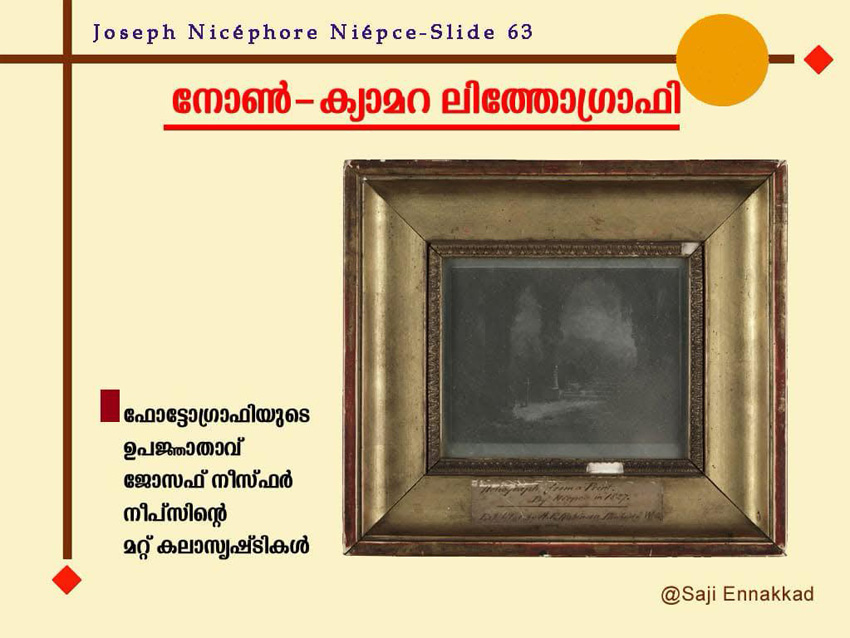
Joseph Nicéphore Niépce carried out his lithographic experiments using the camera obscura at his estate in Saint-Loup-de-Varennes.
In 1818, he successfully fixed the image of a horse, though it lasted only about three months.
By 1820, he had discovered that a chemical compound known as Bitumen of Judea, extracted from certain materials, could be applied to glass or stone surfaces. Through the action of light, an image could be fixed onto these coated surfaces.
In July 1822, he achieved a notable breakthrough. He created a negative image on a glass surface coated with Bitumen of Judea and produced an etched image of Pope Pius VII. However, while attempting to produce a positive image, the glass negative was unfortunately lost.
By 1824, many of his experiments were yielding successful results. He created etched images on various surfaces — including lead-coated copper plates, glass, and stone slabs — and produced contact prints from their negatives.
One such important work is shown in this slide, representing Niépce’s early mastery of heliographic and etching techniques.
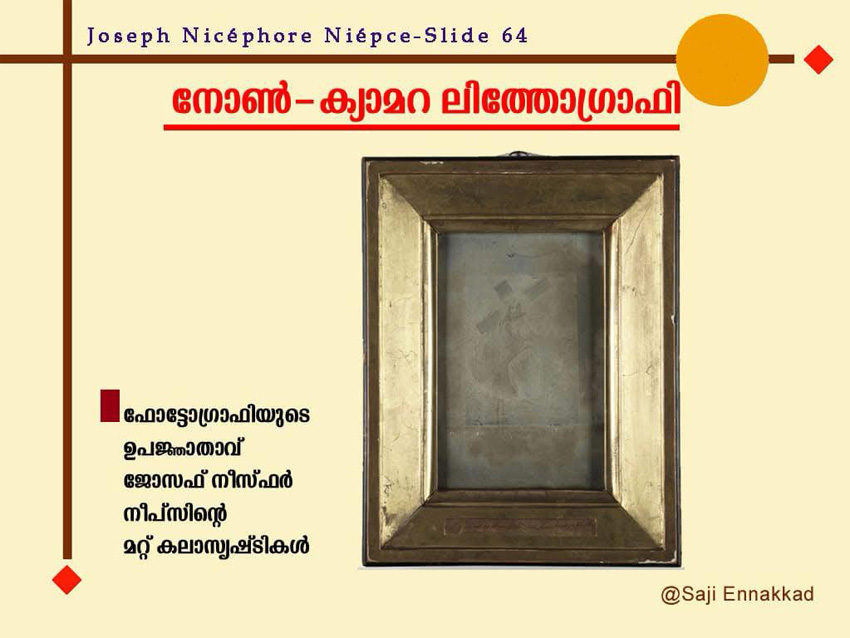
Joseph Nicéphore Niépce conducted his lithographic experiments using the camera obscura at his estate in Saint-Loup-de-Varennes.
In 1818, he succeeded in fixing the image of a horse, but the image survived for only about three months.
By 1820, he had discovered that Bitumen of Judea — a light-sensitive chemical substance — when applied to glass or stone surfaces, could fix an image through the action of light.
In July 1822, he achieved an important breakthrough. On a glass surface coated with Bitumen of Judea, he created a negative image and produced an etched image of Pope Pius VII. However, while attempting to produce a positive image, the glass negative was lost.
By 1824, many of his experiments were successful. He created etched images on various surfaces, including lead-coated copper plates, glass, and stone slabs, and produced contact prints from their negatives.
One such significant work — an image of Christ carrying the Cross — is shown in this slide, representing Niépce’s early mastery of heliographic and etching techniques.
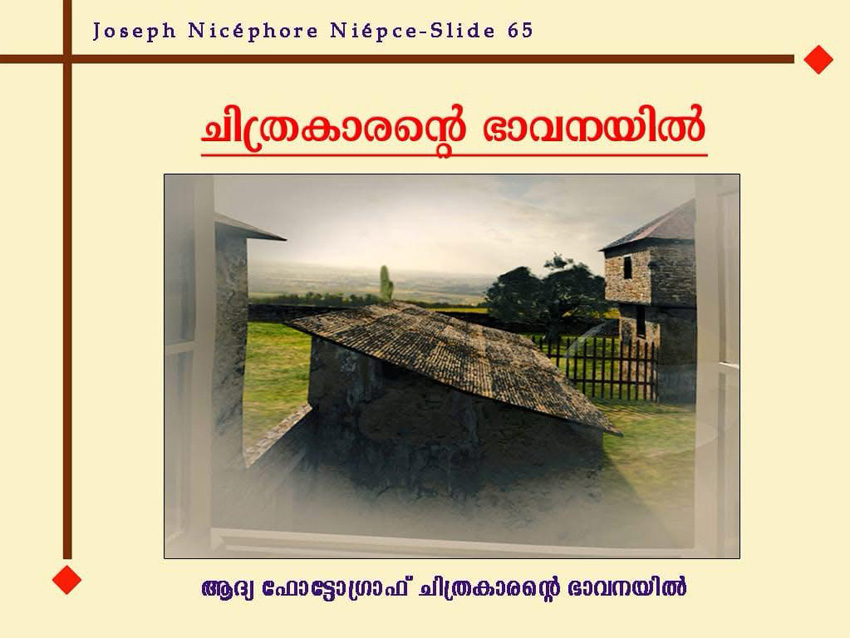
The world’s first successful photograph —
“View from the Window at Le Gras” —
reimagined through the vision of an artist.
This artistic interpretation brings to life the historic courtyard, rooftops, and sky that Joseph Nicéphore Niépce captured through his upper-floor window — the very scene that marked the birth of photography.